
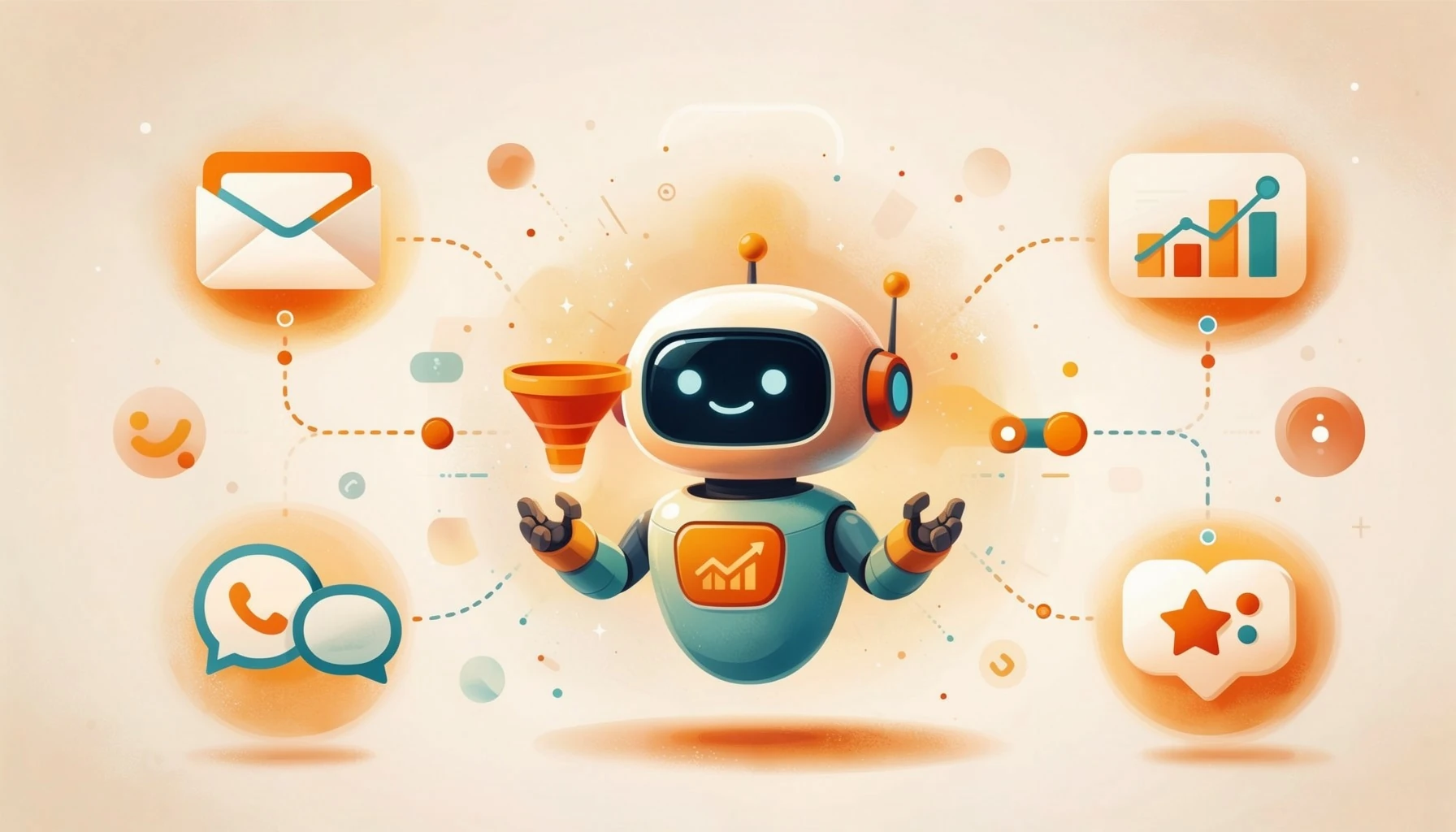
AI marketing automation in 2026 is no longer an experiment — it is core marketing infrastructure. By 2026, an estimated 91% of marketing teams have integrated AI tools into their daily workflows, up from 63% just a year earlier. Yet most businesses still treat it as a magic button: they buy a tool, flip it on, and wonder why nothing moves. This complete guide cuts through the hype to explain what AI marketing automation actually is, how it differs from the old rule-based automation you may already use, eight real examples that deliver results today, the 2026 tools landscape, a workflow blueprint you can copy, the silent killers of automation projects, and a simple first step you can launch this week.
What AI Marketing Automation Actually Is
AI marketing automation combines machine learning, generative AI, and workflow automation so that marketing systems can not only execute repetitive tasks but also decide, write, personalize, predict, and improve without a human touching every step. Traditional automation follows rigid “if X then Y” rules; AI-powered automation reads the messy reality of real customers — vague questions, missing fields, changing intent — and adapts on the fly.
A useful way to think about it: traditional automation is a vending machine — you press the right button and get the same result every time. AI marketing automation is a skilled assistant — it listens, interprets, drafts, decides the best next step, and only escalates to you when judgment truly matters. The AI automation market is growing at a 23.4% compound annual growth rate, projected to reach $19.6 billion by 2026, while the broader marketing automation market is expected to climb from roughly $6.65 billion in 2024 to $15.58 billion by 2030. This is not a trend — it is the new operating model for growth.
Marketing Automation Market Growth ($B)
Sources: Dataopedia 2026, GTM 8020, AdAI News — global market projections
How It Differs From Traditional Automation
The difference matters because teams that expect “the same automation, with AI sprinkled on top” end up disappointed. The shift is structural, not cosmetic. Here is a side-by-side comparison:
| Dimension | Traditional Automation | AI Marketing Automation (2026) |
|---|---|---|
| Logic | Fixed rules and if-then branches | Models + rules; adapts to ambiguous inputs |
| Content | Pre-written templates | Generates copy, subject lines, and images per segment |
| Segmentation | Manual static lists | Self-updating clusters from behavior signals |
| Send timing | Fixed schedules (e.g., every Tuesday 9 AM) | Predictive send-time per individual |
| Error handling | Workflow breaks on edge cases | Handles missing fields and rephrases naturally |
| Optimization | Human reviews dashboards weekly | Continuous learning loops and auto A/B testing |
| Human role | Build every step manually | Set strategy, guardrails, and approve exceptions |
The practical consequence: AI marketing automation examples in 2026 routinely lift conversion rates not by 5–10% but by multiples, because every touchpoint — message, channel, timing, offer — is tuned for the person receiving it. Gartner estimates that roughly half of generative AI projects still fail, almost always because of poor use-case selection. That is why the examples and workflows below are deliberately specific.
8 Real AI Marketing Automation Examples Across Channels
These are not hypotheticals. Each example below exists in production somewhere today — and the first few map directly onto the automation systems we build for local businesses at Anagata IT Solutions.
A local clinic or real-estate firm’s AI assistant replies within seconds at 11 PM, answers pricing questions in natural Hindi, Hinglish, or English, and captures name, number, and need before saving everything to the CRM and notifying the owner. Speed to lead kills deals — AI marketing automation turns that weakness into a strength. See how our WhatsApp automation does this end-to-end.
Rush Home, a residential real-estate brokerage, runs an AI agent that scores a database of more than 11,000 leads using behavioral signals, CRM history, and firmographics — surfacing only the handful worth a human call. Sales teams stop dialing cold and start closing warm.
When a prospect goes quiet, the AI sends two or three gentle, context-aware reminders — referencing exactly what they asked for — until the lead replies, books, or politely says no (at which point it stops instantly). We build exactly this in our lead follow-up automation service.
A content engine repurposes a single blog post into a Google Business post, an Instagram caption with emojis, a WhatsApp broadcast, and an email newsletter — each rewritten for that platform’s voice, then scheduled to publish automatically. This is the core of our social media content automation.
After a great service experience, the AI sends a polite review request with a one-tap link; when reviews arrive, it drafts warm, on-brand replies for approval. It never argues with a negative review — it routes that one to a human immediately. Our review management automation handles this cycle.
Platforms like ActiveCampaign and Klaviyo let AI analyze behavioral patterns to decide what each subscriber should see next, when to send it, and on which channel — email, push, SMS, or in-app — lifting open and click rates versus batch-and-blast campaigns.
Content teams use AI to continuously analyze live Search Trends, detect rising intent in their sector, and instantly pivot campaigns around emerging demand — turning a trending topic into a landing page and ad set in hours, not weeks.
AI media-buying platforms manage budgets across Google Ads, Meta, TikTok, and LinkedIn — pausing underperformers, shifting spend to winners, and regenerating creative variations — while a human reviews only high-level approvals. The AI in social media segment alone is projected to reach $15.8 billion by 2032.
The 2026 Tools Landscape
The biggest shift in the 2026 tools landscape is that point solutions are being replaced by platforms with embedded AI agents. Most AI tools are not designed to replace your CRM or marketing automation suite; they supercharge it. Here is an honest, current comparison of the categories that matter:
| Tool / Category | Best For | Key AI Strength in 2026 |
|---|---|---|
| HubSpot (Breeze) | All-in-one CRM + marketing | Native AI copilots across content, sales, and service |
| ActiveCampaign | Email + predictive sending | AI-suggested segmentation and conditional content |
| Klaviyo | E-commerce lifecycle | Behavior-driven flows, send-time optimization |
| Zapier / Make / n8n | Workflow orchestration | Connecting AI models to 6,000+ apps without code |
| Salesforce Agentforce | Enterprise CRM journeys | Autonomous agents with deep CRM context |
| Jasper / Surfer SEO | Content + SEO | Brief-to-blog workflows with SERP optimization |
| Ryze AI & media-buying agents | Paid advertising | Autonomous cross-channel budget management |
| Custom agents (Lindy, Gumloop) | Repeating niche workflows | Human-like handling of messy, real-world inputs |
Adoption data tells the story clearly: 87% of marketers now use AI tools, 95.4% of B2C marketers are using AI in campaigns, and SMB adoption of AI automation has jumped from 22% in 2024 to 38% in 2026. Almost two-thirds of companies (67%) now actively deploy marketing automation, according to Forrester-linked estimates.
AI Adoption Among Marketing Teams
Sources: Averi AI 2026 State of Marketing AI Tools, Omnibound 2026, MoEngage 2026
A Simple Workflow Blueprint That Actually Works
The mistake most teams make is building a giant end-to-end system on day one. Instead, every successful AI marketing workflow follows the same five-stage blueprint:
| Stage | What Happens | AI’s Role | Human’s Role |
|---|---|---|---|
| 1 Trigger | An event starts the flow (form, message, cart abandon) | Classifies intent and priority | Defines which triggers matter |
| 2 Enrich | Pull CRM data, behavior, past conversations | Fills gaps, dedupes, predicts need | Approves data sources |
| 3 Decide | Choose channel, message, timing, next best action | Scores and selects the optimal path | Sets guardrails and budgets |
| 4 Act | Send, post, book, update CRM, notify | Generates content and executes | Reviews exceptions only |
| 5 Learn | Measure outcomes and feed results back | Adjusts model weights and segments | Reviews dashboards weekly |
Apply this blueprint to WhatsApp lead capture:
- ✓ Trigger: Customer sends “Hi! Price?” on WhatsApp at 11 PM.
- ✓ Enrich: AI checks CRM history; recognizes repeat visitor.
- ✓ Decide: High-intent signal → reply instantly with tailored price + offer.
- ✓ Act: AI books a consultation slot; saves contact; notifies owner.
- ✓ Learn: If 11 PM chats convert best, AI shifts follow-up timing accordingly.
“The difference between amateur and professional automation is error handling. Amateurs build the happy path. Professionals plan for failure.”
A principle that applies to AI marketing automation more than any technology before it.
Common Mistakes That Kill Automation Projects
Roughly 43% of failed AI marketing automation projects suffer from insufficient planning, and analysts estimate that up to 95% of AI pilots never scale. The failures follow predictable patterns. Avoid these seven:
- ✗ Starting with the tool, not the workflow. The single biggest predictor of failure is choosing software before mapping the process. Buy the workflow first, then the tool.
- ✗ Automating a broken process. If your manual follow-up already leaks leads, AI will just leak them faster. Fix the process first.
- ✗ No error handling or human escalation. The Air Canada chatbot that promised refunds it couldn’t deliver is the cautionary tale: every AI workflow needs a “I don’t know” path that routes to a human.
- ✗ Garbage data in, embarrassing outputs out. Poor CRM hygiene and missing fields lead to wrong personalization and cringe-worthy messages. Clean your data before connecting models.
- ✗ Measuring the wrong metrics. Vanity metrics (likes, sends) hide failed ROI. Track leads, bookings, revenue, and reply-rates per workflow.
- ✗ Treating it as a tech project, not a people project. If your team doesn’t trust, understand, or know how to override the AI, they will quietly work around it — and the project dies from neglect.
- ✗ No review-and-approve guardrails. Fully autonomous sending before the AI has proven itself is how brands publish off-brand or offensive content. Start with human approval on every message, then relax as accuracy improves.
Why AI Automation Projects Fail — Interactive Table (Grid.js)
A quick-reference view of the most frequent failure drivers (based on Gartner, Ryze AI 2026, MIT Sloan research)
How to Start With One Small Workflow
Discipline beats ambition. Here is the exact sequence we recommend to every business — and it’s the same approach behind the AI automation systems we deploy:
Pick ONE painful repeated task
List the tasks you do weekly that you hate. Choose the most painful with clear ROI — usually responding to leads.
Map the happy path AND edge cases
Document what happens normally, plus what happens when info is missing, rude, or out-of-scope. Write the human handoff rule.
Ship with human approval ON
Launch on a small segment with every AI action requiring a human OK. Watch real conversations, tune prompts, fix errors.
Measure, then scale
After 2–4 weeks, compare response time, conversion, and hours saved. Only then relax approvals and add the second workflow.
Within a few months, the compounding effect is dramatic: faster response times, no forgotten leads, consistent content, a steady stream of fresh reviews, and the owner’s evenings back. That is exactly the outcome we design for in the Anagata Growth System.
Key Takeaways
AI marketing automation in 2026 is a decision engine plus an execution engine: it decides what each customer needs, writes the message, picks the channel and timing, executes, and learns from the outcome. The market is compounding at 23%+ CAGR, adoption has crossed 90% among marketing teams, and the winners are not those with the most tools — they are those who start small, plan the process, handle errors, and keep humans in the approval loop until trust is earned. Start with one workflow this week: instant AI replies to incoming leads. It is the highest-ROI, lowest-risk entry point, and the perfect foundation for everything else.
Ready to Automate Your First Workflow?
We help local businesses deploy AI marketing automation for WhatsApp replies, lead follow-up, content, and reviews — set up for you in plain words, with you always in control.
Book a Free Demo →Related Articles

Your Website Is Silently Repelling Customers: How AI Website Generator Builds Lead-Generating Sites in Minutes
AI Website Development • 12 min read Your Website Is Silently Repelling Customers: How AI Website Generator Builds…

The Scary Cost of Ignoring Reviews: AI Review Management Guide 2026
AI Automation • 12 min read The Scary Cost of Ignoring Reviews: How to Automate Google Review Requests…
Best AI Marketing Automation Tools for Small Businesses in 2026: Honest Comparison
10 Best AI Marketing Automation Tools for Small Businesses in 2026 Marketing Automation • 15 min read An…